Donation Amount. Min £2

Health

Image via gov.uk


Unemployed nurses and health workers from Kenya will have the chance to work in the UK as part of a new scheme requested by the Government of Kenya and launched by President Kenyatta today (29 July) during his visit to London.

In a programme to share knowledge and expertise, Kenyan health professionals and health managers will benefit from a special route to work in the UK, before returning to work in Kenya’s health sector. The agreement is open to Kenya’s surplus health workers who are qualified but unemployed, ensuring the process is managed for Kenya’s benefit.

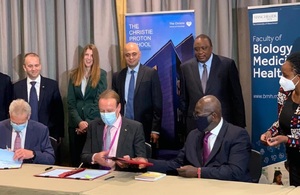
UK Health Secretary, Sajid Javid, and Kenya’s Cabinet Secretary for Labour Cooperation, Simon Chelugui, signed the agreement on Kenyan recruitment into the UK’s National Health Service. It came on the third day of President Kenyatta’s visit to London, on a tour of the Royal College of Physicians in London. The special programme came at the request of the Government of Kenya to channel nurses currently unemployed into jobs.

The President also witnessed the signing of the Kenya-UK Health Alliance, which will bring together UK and Kenyan institutions – universities, teaching hospitals – cooperating on health partnerships.

One of the flagship partnerships is on improving cancer treatment for Kenyans, thanks to a tie-up between Kenyatta University Teaching Research and Referral Hospital and the University of Manchester/Christie NHS Foundation Trust. It will help improve prevention and management of cancer in Kenya, and promote Kenya a regional hub for cancer treatment.

Jane Marriott, the British High Commissioner to Kenya, said:

Our health partnership with Kenya is 30 years old and growing stronger by the month. This new agreement on health workers allows us to share skills and expertise even further, and is a fantastic opportunity for Kenyans to work in the UK.

From COVID-19 vaccines and genomic sequencing, to exchanges on cancer research and treatment to help Kenya treatment more cancer patients at home, the UK has a long and proud history of support for Kenya’s health sector. The signing of the Kenya-UK Health Alliance by President Kenyatta on his visit to the UK is the latest chapter in our flourishing partnership.

The UK’s Secretary of State for Health, Sajid Javid, said:

We have a historic and mutually respectful relationship with Kenya. This has been strengthened by working closely with Kenya during the pandemic and sharing UK vaccine doses to support Kenya’s fight against COVID-19.

Our healthcare agreement will make the most of UK and Kenyan health expertise which will be beneficial to both countries, with the exchange of knowledge and training which will provide first class healthcare.

It comes after a flurry of announcements of UK support for Kenya’s COVID-19 response, as part of our flourishing Health Partnership, signed by the UK’s Foreign Secretary, Dominic Raab, and Kenya’s Cabinet Secretary for Health, Mutahi Kagwe, during a visit to Nairobi in January 2021.

On 28 July, Prime Minister Johnson confirmed the donation of 817,000 COVID-19 AstraZeneca vaccine doses for Kenya – half a bilateral donation, and half a UK donation through the COVAX facility – while earlier this month we announced new support on genomic sequencing with KEMRI to tackle emerging COVID-19 variants. Kenyan and British scientists at KEMRI and Oxford University were closely involved in the development of the AstraZeneca vaccine, through trials of the vaccine through KEMRI Kilifi. - Foreign, Commonwealth & Development Office, GOV.UK

Photo via Anadolu Agency


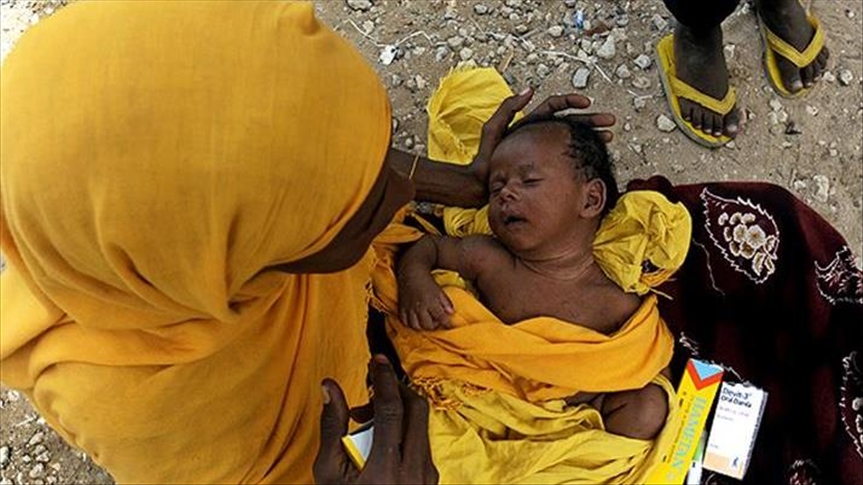
Kenya’s Health Minister Mutahi Kagwe warned on Wednesday that the nation is at the beginning of a fourth coronavirus wave, citing increased infections.

Kagwe told county governments to ensure that they have sufficient intensive care unit (ICU) beds and oxygen to deal with the new cases.

“I would like to appeal to the county governments to start ensuring that there is sufficient oxygen in each county. Of particular importance is ensuring that not only is there oxygen but the oxygen has been properly piped. We can already see an increase in demand of ICU beds [and] we can see an increase in demand of oxygen requirements,” he said.

The Health Ministry said the Delta variant is now dominant in Kenya.

This comes as the UK donated 817,000 COVID-19 vaccines to Kenya.

More vaccines are set to arrive in Kenya next week and Kagwe said: ”Kenya will receive 1,760,000 doses of Pfizer from the US government, 410,000 doses of AstraZeneca from the UK government, 235,000 doses of AstraZeneca from Greece and 55,000 doses of AstraZeneca from Latvia as part of bilateral donations.”

A total of 1,006 people tested positive on Wednesday for the virus in Kenya from a sample size of 5,584 tested in the last 24 hours.

The positivity rate is now 18.0%. Confirmed cases are at 199,941 and cumulative tests conducted stand at 2,109,581.

Thirteen people have also died, all being late deaths reported after conducting facility record audits. - Andrew Wasike, Anadolu Agency


The government has announced it has made significant effort towards implementing the five-year plan to eliminate Hepatitis C Virus, which was endorsed in 2018.

Currently, officials from the Ministry of Health, Rwanda’s cure rate for the virus is at 90 per cent among recorded infections.

The officials say that the current progress shows that the national goal to eliminate Hepatitis C virus (HCV) by 2024 is possible, which fore-runs the World Health Organization (WHO) timeline of 2030.

This was revealed on Wednesday July 28 as the country joined the global community in marking World Hepatitis Day, which was celebrated under the theme ‘Hepatitis Can’t Wait’ a call to action to eliminate the viral disease.

Hepatitis is a disease characterized by inflammation of the liver and it has different types; Hepatitis A, B, C, D and E.

Rwanda Biomedical Centre (RBC) says that the program of HCV elimination is at the ‘last mile’ of implementation.

“We have screened five million out of the targeted seven million people aged 15 years and above,” said Dr. Sabin Nsabimana, Director General, RBC during his address on the World Hepatitis Day.

Reduced HVC prevalence

Throughout the years, Rwanda has made significant progress in reducing the prevalence of Hepatitis C virus from 4 per cent to one per cent, currently infections range between one and two per cent.

According to RBC’s report, in the past two years, 50,000 people have been treated for HCV and cured.

Deon Gratias Nshimiyimana, resident in Niboye Sector, Kicukiro District said he tested positive for HVC in July 2020 and after six months of treatment got cured.

 “My doctor advised me to take my medicines with a complete healthy meal and to abstain from alcohol.”

“Hepatitis is curable and I would advise everyone to cross check their status in order to get early treatment,” he added.

Effectiveness of awareness campaigns

“The initial phase of the program which consisted of awareness campaigns was run effectively until we moved to decentralized health access,” said Dr. Janvier Serumondo, Director of Viral Hepatitis and Sexually Transmitted Infections, RBC.

Covid 19 has prompted different awareness approaches to be adopted.

“Due to Covid, we are no longer able to do mass awareness since large gatherings are prohibited,” said Dr. Leonidas Batamugira, director of Remera Health Centre.

“Nowadays, no one wakes up to go to the hospital solely for Hepatitis screening, however, we persuade those who come for medical consultations to also undergo hepatitis tests and those whose results are positive, they are given proper follow up,” he added.

Decentralized Health care access

Access to screening and treatment services has been shifted from four health facilities to all health centres across the country.

Over 1000 healthcare workers have been trained to support specialists and provide hepatitis services in different health centres.

Hepatitis vaccination

About 4,000,000 people have been tested for HBV and over 5,000 are on a lifelong HBV treatment while over 7,000,000 people including children and adults have been vaccinated for HBV.

Hepatitis B virus (HBV) prevention is mainly done by vaccination offered to children as part of the pentavalent vaccination package from 2002.

This means that the generation aged 0-18 years is vaccinated and it confers protection for the lifetime.

“Since 2002, we have been immunizing young children to build a hepatitis-free generation,” said Serumondo.

HCV does not have a vaccine but once screened, six month long treatment proves to cure by 90 per cent.

Worldwide, hepatitis B and C are the most common which result in three million new infections per year and 1.1 million deaths, with a person dying every 30 seconds from a hepatitis related illness.

In Africa, chronic viral hepatitis affects over 70 million people and continues to take the lives of many, especially those who can’t afford to access quality health care, however, Hepatitis can be prevented, screened, treated, and eliminated.

Serumondo says the ‘last mile’ of the program includes the screening of the remaining numbers and treating confirmed cases, preparation for WHO HCV elimination validation, and strengthening preventive interventions for HBV and increasing efforts towards HBV elimination. - Alice Kagina, The New Times

About IEA Media Ltd

Informer East Africa is a UK based diaspora Newspaper. It is a unique platform connecting East Africans at home and abroad through news dissemination. It is a forum to learn together, grow together and get entertained at the same time.

To advertise events or products, get in touch by info [at] informereastafrica [dot] com or call +447957636854.
If you have an issue or a story, get in touch with the editor through editor[at] informereastafrica [dot] com or call +447886544135.

We also accept donations from our supporters. Please click on "donate". Your donations will go along way in supporting the newspaper.

Get in touch

Our Offices

London, UK
+44 7886 544135
editor (@) informereastafrica.com
Slough, UK
+44 7957 636854
info (@) informereastafrica.com

Latest News

I will be ODM’s presidential candidate if party runs alone in 2027 - Oburu

I will be ODM’s pres...

ODM party leader Dr. Oburu Oginga addresses residents in Magarini to rally behind party candidate H...

Somali president says his country got Turkey’s support amid sovereignty threats

Somali president say...

Turkish President Recep Tayyip Erdogan (R) and Somali President Hassan Sheikh Mohamud (L) hold a jo...

Koome promises timely and responsive Justice in 2026

Koome promises timel...

Chief Justice Martha Koome vows to deliver timely, accessible, and responsive justice in 2026, guide...

U.S. Federal Probes Expose Massive Fraud in Minnesota Programs, With Stolen Funds Laundered Into Kenyan Real Estate

U.S. Federal Probes...

U.S. Federal authorities in Minnesota have uncovered extensive fraud targeting state-funded programs...

For Advertisement

Big Reach

Informer East Africa is one platform for all people. It is a platform where you find so many professionals under one umbrella serving the African communities together.

Very Flexible

We exist to inform you, hear from you and connect you with what is happening around you. We do this professionally and timely as we endeavour to capture all that you should never miss. Informer East Africa is simply news for right now and the future.

Quality News

We only bring to you news that is verified, checked and follows strict journalistic guidelines and standards. We believe in 1. Objective coverage, 2. Impartiality and 3. Fair play.

Banner & Video Ads

A banner & video advertisement from our sponsors will show up every once in a while. It keeps us and our writers coffee replenished.