
The Budget Summary reveals a government navigating a Ksh.1.11 trillion deficit, revised-down growth projections, surging oil prices, and a Ksh.1.46 trillion interest and pension bill, yet pressing forward with ambitious infrastructure, education and healthcare expansion.
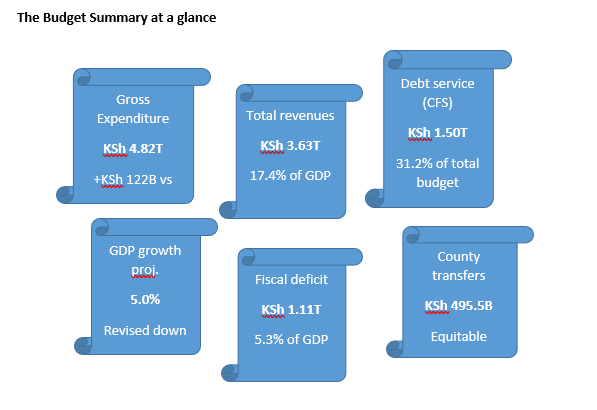
In the budget estimate, Kenya’s gross expenditure Ksh.4,817.8 billion, which is Ksh.69.3 billion above the February Budget Policy Statement (BPS) ceiling, adjusted upward for salary shortfalls and development partner project realignments.
The Consolidated Fund Services (interest and pensions) stand at Ksh.1,501.3 billion, a staggering 31.2% of the entire budget. Domestic interest alone (Ksh.986.7B) exceeds the full education budget which is Ksh.668.3B.
The Middle East conflict stands as a defining new risk, which has seen crude oil trade at USD 100 per barrel. This has triggered petrol price spikes, forced a VAT cut on fuel, pushed inflation to 5.6%, and caused GDP growth to be revised down from 5.3% to 5.0%.
The development expenditure captured in this budget summary has a ratio of 29.0%, which falls below the statutory 30% PFM Act floor, and the Treasury openly acknowledges this breach.
Public debt present value (PV) remains at 65.3% of Kenya’s Gross Domestic Product (GDP) against a 55% statutory ceiling, and the convergence path does not reach compliance within the budget's medium-term window.
Kenya's FY2026/27 Budget is the government's most externally disrupted budget since COVID-19.
The National Treasury's 30 April Budget Summary is the definitive pre-implementation document, which has been prepared against the backdrop of a new conflict in the Middle East since late February 2026. Global oil prices surged from USD 63.06 per barrel in February 2026 to around USD 100 per barrel by April 2026.
The direct domestic consequence was a jump in petrol prices, which jumped from Ksh.178.28 to Ksh.197.60 per litre, while diesel rose from Ksh.166.54 to Ksh.196.63 per litre in a period of just two months.
In response, the government temporarily lowered the VAT rate on fuel from 16% to 8% for three months in April 2026 and deployed the Petroleum Development Levy Fund to protect low-income kerosene users.
The inflation rate, though still within the CBK's target band, rose to 5.6% in April 2026 from 4.1% in April 2025, a notable acceleration driven by fuel and food price pressures from erratic weather.
As a result, the 2026 GDP growth projection was revised downward from 5.3% to 5.0%, with the Treasury noting that sustained high oil prices could weaken it further.
"Should the conflict persist, resulting in prolonged supply disruptions and sustained high oil prices, growth would weaken further relative to the current projection,” the National Treasury Budget Summary highlights.
On the positive, Kenya’s foreign exchange reserves stood at USD 13,354 million in March 2026, which is equivalent to 5.7 months of import cover, well above the 4-month regional threshold.
The KES/USD exchange rate remained stable at 129.4. The NSE 20 Share Index surged 67.2% year-on-year to 3,570 points by April 2026, and the 91-day T-bill rate declined to 7.5% from 8.5%, easing the cost of domestic borrowing.
The Ksh.4.82 trillion gross expenditure
While the Cabinet-approved Budget Policy Statement set a framework of Ksh.4.75 trillion, the final Budget Summary tabled on 30 April reflects a gross expenditure figure of Ksh.4,817.8 billion, a whole Ksh.69.3 billion above the 2026 BPS ceiling.
This upward revision resulted from adjustments for salary shortfalls in Ministries, Departments and Agencies (MDA’s), emerging critical expenditures, and realignment of development partner-funded projects to actual commitments.
The Executive is set to receive the lion’s share, 58.5% of the budget, amounting to Ksh.2,817.4B. This is followed by the Consolidated Fund Services (debt and pension), set to receive Ksh.1,501.3B, translating to 31.2%.
The County's equitable share follows far below at Ksh.420.0B. Parliament surprisingly continues to receive a bigger share than the Judiciary; the amount due to them is Ksh.48.7B. The Judiciary receives a paltry KES 30.4B. Share of total gross expenditure amounts to Ksh.4,817.8 billion.
Of interest is the Consolidated Fund Services (CFS); it covers domestic interest Ksh.986.7B, comprising foreign interest at Ksh.267.5B, and pensions together with salaries at Ksh.247.1B.
This expenditure line absorbs Ksh.1,501.3 billion, or 31.2% of the entire budget. This single line item dwarfs every productive sector allocation combined. Interest payments alone total Ksh.1,254.2 billion, which, is more than the education and national security budgets combined.
The sectoral allocations
The Budget Summary provides granular program-level detail across 15 thematic areas amounting to Ksh. 2,342.3 billion within the national government's ministerial envelope. The headline figures are as follows:
The Education sector leads with KES 668.3B accounting for a 28.5% share. This is followed closely by the National Security docket which is set to receive Ksh.566.9B or a 24.2% share.
Next is the roads sector, which is to receive Ksh.230.3B or a 9.8% share of the budget funds. The Housing & Works sector will receive Ksh.135.8B or 5.8% of the budget. The
Environment and Water sectors will receive Ksh.117.5B or 5.0% of the budget. Youth and Women, together with equity programs will receive Ksh.109.7B or 4.7% share of the budget.
The health sector will remain underfunded when it receives Ksh.170.7B or 7.3%. Agriculture, the backbone of the economy, will get Ksh. 63.0B or 2.7% share of the budget.
In the 2026/27 budget, education is the single largest thematic allocation. Teachers Service Commission (TSC) teacher salaries dominate at Ksh.406.6B. Higher Education Loans Board receives Ksh.56.7B, while Free Day Secondary is set to receive Ksh.54.6B and Junior Secondary School (JSS) Capitation has been allocated Ksh.30.9B.
The government intends to convert over 20,000 intern teachers to more stable terms by spending KES 4.9B from Jan 2027.
In the budget, the Defense portfolio is to receive Ksh.250.0B, the largest for any single agency. The National Police Service is set to get Ksh.144.4B. The
National Intelligence Service will receive Ksh.58.6B, as police motor vehicle leasing will consume Ksh. 13.0B and police modernization taking up Ksh.7.0B. The Prisons and Corrections Department will receive Ksh.42.7B.
In the health sector, Primary Health Care Fund will receive Ksh.19.1B, while the Kenyatta National Hospital will have Ksh.18.8 B for recurrent expenditures.
Another Ksh.18.8B will go to the Kenya Medical Supplies Authority (KEMSA) for medicines. Ksh.20.9B will support the Global Fund.
The Universal Health Coverage health workers conditional grant will be Ksh.8.9B, while the Community Health Promoters stipend will consume Ksh.3.2B of the total budget.
The budget also lays out plans to fund the agriculture sector, where the Fertilizer Subsidy Program leads the pack at Ksh.18.0B.
The National Agricultural Value Chain Development Project (NAVCDP) is set to receive Ksh.4.7B and the Food Systems Resilience Project is earmarked to receive Ksh.5.4B.
The Kenya Livestock Commercialization Project (KeLCoP), a six-year (2021–2027) government initiative, in partnership with IFAD, which, aims to increase incomes and resilience for 110,000 poor households in rural Kenya, will receive Ksh.1.3B. Pastoral economies de-risking is set get Ksh.3.3B from the budget.
County governments receive a total allocation of Ksh.495.7 billion, made up of the equitable share (Ksh.420.0B), unconditional additional allocations of Ksh.1.98 billion (from mineral royalties and court fines), conditional national government grants of Ksh. 16.3 billion, and conditional development partner grants of Ksh. 57.4 billion. The equitable share of Ksh.420 billion represents 20.49% of the most recent audited revenue (FY2022/23: Ksh. 2,050.1 billion), which, is still compliant with the constitutional 15% floor.
Infrastructure and BETA priorities
The Bottom-Up Economic Transformation Agenda (BETA) is Kenya's economic development blueprint for 2022-2027, and has been allocated Ksh.379.5 billion towards its priority clusters.
Under BETA, Infrastructure commands the largest cluster at Ksh.134.8 billion, followed by Social Sectors at Ksh.122.5 billion.
Roads infrastructure alone will receive Ksh.230.3 billion. This will see Ksh.118.1 billion used for maintenance, Ksh.64.2 billion for rehabilitation, and Ksh.48.1 billion for new construction and bridges.
The SGR Phase 2B and 2C (369km) extension attracts KES 20.8 billion, making it the single largest transport capital project. The Dongo-Kundu Special Economic Zone is allocated Ksh.4.2 billion.
President William Ruto’s housing project also stands out with Ksh.135.8 billion. Ksh.50.7 billion is slated for Affordable Housing Units construction and Ksh.20.9 billion for Social Housing Units.
The National Infrastructure Fund (NIF), established in March 2026 and seeded by KPC IPO proceeds and Safaricom stake divestiture proceeds, is positioned as the primary vehicle for future large-scale infrastructure beyond the annual budget.
The debt crisis in numbers
The most alarming figures in the Budget Summary are embedded in the fiscal tables. The Present Value (PV) of total public debt stood at 65.3% of GDP in June 2025, over 10 percent points above the 55% PFM Act statutory ceiling.
The government's own projections indicate this will gradually decline to 65.6% in 2026, then fall to 65.0% (2027), 64.2% (2028), and 63.1% (2029), all these figures, still far above the target even by the end of the decade.
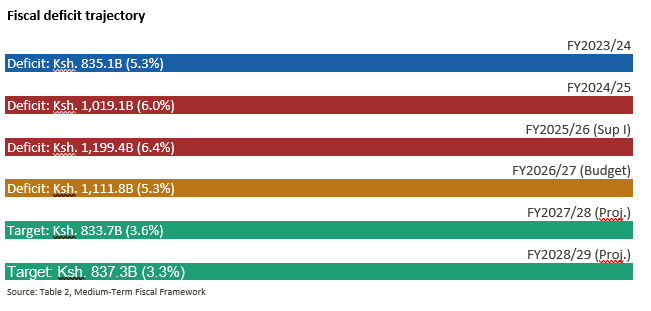
The current budget deficit of Ksh.1,111.8 billion will be financed by net domestic borrowing of Ksh.995.7 billion (4.8% of GDP) and net external financing of Ksh.116.2 billion.
The heavy domestic tilt represents 78% of borrowing per the approved 2026 Medium-Term Debt Management Strategy and reflects a deliberate risk management by reducing foreign exchange exposure.
Domestic gross debt has grown to Ksh.8,295.3 billion (39.8% of GDP), while gross public debt stock now totals Ksh.14,122.1 billion.
Currently, Kenya’s development expenditure ratio stands at 29.0% of ministerial spending in FY2026/27, a figure below the statutory 30% PFM Act minimum.
Treasury acknowledges this deviation, attributing it to the rigidity of recurrent and debt service obligations. Recovery is projected at 31.4% in FY2027/28 and 33.7% in FY2028/29.
Fiscal responsibility scorecard
Development ratio: 29.0% — MISS
PFM Act requires 30% minimum of ministerial spending. The 2026/27 budget falls one percentage point short. Debt service rigidity is cited as the cause. Medium-term recovery projected.
Wage bill: 23.3% — PASS
The PFM limit is 35% of national government revenues. At 23.3% in FY2026/27 (declining to 22.2% and 21.5% in the two outer years), this principle is comfortably met.
Borrowing for development — PASS
All borrowing is documented as applied to development expenditure, not recurrent — consistent with PFM Act Section 15 and the approved MTDS framework.
Debt sustainability — AT RISK
Present Value (PV) of debt at 65.3% of GDP against a 55% ceiling. The trajectory shows gradual convergence (63.1% by 2029) but Kenya remains at high risk of debt distress as per IMF classification.
A double-edged budget
Kenya's FY2026/27 Budget Summary is a document of managed ambition. The headline gross figure of Ksh.4.82 trillion signals expansionary intent, yet the internal composition tells a different story.
The Consolidated Fund Services, which, is primarily interest payments on past borrowing, consumes Ksh.1,501.3 billion, or 31 cents of every Kenya Shilling budgeted.
Domestic interest alone (Ksh.986.7 billion) exceeds the entire education allocation (Ksh.668.3 billion). This is the defining structural constraint of Kenya's fiscal architecture.
The Middle East shock adds a new layer of vulnerability not present in the February BPS. Oil at USD 100 per barrel stresses the current account, pressures inflation, raises production costs, and can dampen private sector credit demand, precisely when the government needs private investment to complement its fiscal stimulus.
The GDP growth downgrade from 5.3% to 5.0% is probably optimistic if the conflict extends through the fiscal year.
In the budget, education investment is substantial and programmatically detailed; the housing agenda has real capital behind it; county transfers are constitutionally compliant and indexed upward; and the debt management strategy's shift toward longer-maturity domestic instruments is structurally sound. The National Infrastructure Fund (NIF) and proposed Sovereign Wealth Fund (SWF) represent genuine institutional innovation if implemented with governance discipline
However, the budget does not lay out a roadmap towards pragmatic and structured debt management. In the foreseeable future, debt service will keep consuming nearly a third of the budget.
The medium-term path to 3.3% of GDP by FY2028/29 requires revenue growth and expenditure discipline that have historically proven elusive.
Revenue underperformance, which, was over Ksh.115 billion off-target in FY2025/26, means the Ksh.120.3 billion Finance Bill 2026 revenue yield is load-bearing.
If Parliament weakens those measures, the fiscal consolidation plan unravels, probably with more debt consequences. Citizen Digital