
But the effects of political violence can continue long after the violence itself has ended. The immediate effects of war, such as poverty, displacement and death, are well documented. Much less is known about how long-term exposure to political violence – meaning living in communities that have experienced these kinds of attacks – affects the risk of later abuse at home, among peers or at school.
We are development economists and public health experts studying the long-term effects of political violence on human development in the global south. We set out to investigate if growing up in communities with a history of political violence increases children’s and young people’s risk of experiencing other forms of violence later in life.
We analysed data from 35,439 young people, aged 13 to 24, from nine African countries. These are Côte d’Ivoire, Kenya, Malawi, Mozambique, Namibia, Nigeria, Uganda, Zambia and Zimbabwe.
We linked nationally representative surveys on violence against children and youth with data on past political violence events from the Armed Conflict Location & Event Data Project, which tracks the timing and location of political violence across Africa.
This allowed us to see if someone’s past, long-term exposure to political violence in their community was linked to their current experience of emotional, physical or sexual violence from peers, friends or relatives.
Our research shows that the effects of exposure to political violence over at least 15 years can seep into homes, disrupt relationships and adversely affect the everyday lives of children and young people.
We found that long-term exposure to political violence significantly increases the risk of interpersonal violence. This refers to violence between individuals, such as within families, within intimate relationships or in peer groups.
These findings suggest that a child born into a community with a history of political unrest is at higher risk of abuse as they grow into a young adult, even if the “active” violence has long cooled down.
The findings
Our most striking discovery is that the consequences of past political violence unfold over a long period of time.
We found that long-term exposure (over 15 years) was associated with a much higher likelihood of several forms of interpersonal violence against children and youth. Interestingly, short-term exposure (violence occurring over one to five years) showed no significant association.
Political violence events in nine African countries
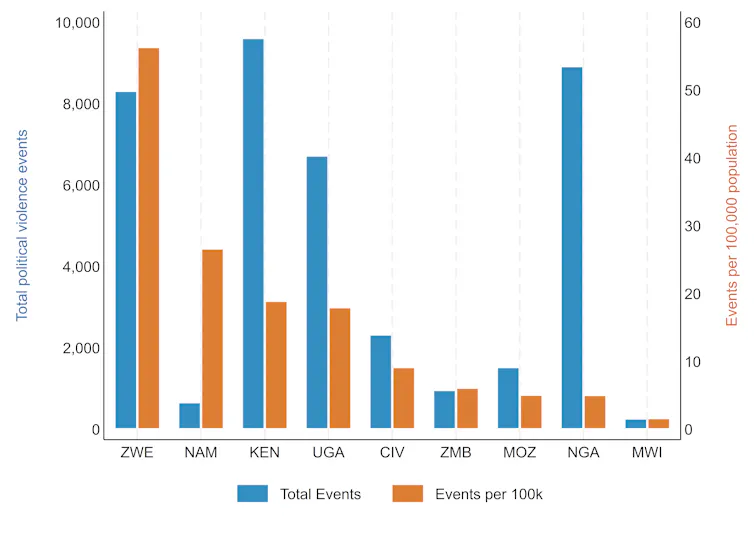
Specifically, we found that long-term exposure to political violence increases the risk among children and youth of:
-
sexual violence among poorer households by as much as 16.9%
-
emotional violence from family members (such as being told they are not loved or being ridiculed) by 5.5%
-
physical violence from intimate partners (like slapping, punching or kicking) by 3.0%.
The drivers
Why would past political violence lead to subsequent violence against children and youth in the home, at school or between friends?
Our research and related studies point to five possible reasons.
-
A culture of insecurity: constant political unrest creates high levels of stress and anxiety for everyone. In many cultures, men feel pressured to be “protectors” and “providers”. When political violence makes this impossible, the resulting distress can lead to more aggressive behaviour within the family.
-
Social learning: when young people grow up witnessing violence being used to address political problems, they can “learn” that violence is an acceptable way to handle personal conflicts in their own lives.
-
Shifting social norms: prolonged conflict may change what a society considers “normal”. Violent behaviours that were once rejected can become more tolerated over time.
-
Economic hardship: conflict destroys jobs and livelihoods. We found that adolescents and young adults in the poorest households were the most vulnerable to sexual violence. When families are desperate, young people may be at higher risk of exploitation.
-
Broken systems: long-term political violence may gradually destroy the systems meant to protect children. School closures become more frequent, health and social services deliveries are weakened, and community trust erodes. Without these “safety nets”, there are fewer adults outside the family to spot abuse or help children report it.
What next?
The central recommendation from our study for practitioners working with children and young people in fragile settings is that responses to the consequences of long-term political violence need a much broader view of who needs protection, where and how.
Humanitarian responses cannot focus only on “emergency” needs, such as food aid, immediate healthcare and displacement camps.
Child protection efforts should also invest in preventive community-based services that provide safe spaces and sustained support for children and young people at risk of violence resulting from long-term political unrest.
Our findings suggest that, when assessing a child’s needs and risks, social workers should consider the child’s immediate circumstances and the history of political violence in their community.
Child protection, therefore, cannot just respond to a single shock or crisis. It must counter the long shadow of past conflicts.
-
Child protection must be a core part of conflict response. Programmes shouldn’t just focus on demobilisation or safety from armed groups. They must address safety within homes, schools and communities. This includes investing in mental health and support for caregivers like parents and teachers. If the hidden distress of adults and children is ignored, that harm can be transferred across generations.
-
Targeted support is needed for the most vulnerable. Poverty significantly increases the risk of sexual violence in areas with past political violence. Therefore, interventions like social protection and food security aren’t just about welfare. They are vital tools for preventing violence within and outside the home.
-
Responses must take historical contexts seriously. Preventing violence against children in Africa means looking back at where conflict has reshaped social life. Governments, donors and NGOs need to build institutional and family support systems that can withstand the pressures long-term political violence puts them under.
Treating political violence and child abuse as unrelated problems leaves young people across Africa at risk. Only by addressing the long shadow of political violence can we hope to achieve the global goal of ending all forms of violence against children.