
Huyen Phan displaying her art at Under the Rainbow’s Winter Exhibition 2024. Image Credits: Huyen Phan.
By NAYONIKA MANNA
How prison art helped a mother rebuild her life after jail . As prisons struggle with overcrowding and reoffending, this former inmate’s journey shows how creativity can restore identity, mental health and hope.
We all make mistakes in life – some minor, others with lasting consequences. For a few, however, those mistakes lead to prison, a place that strips away freedom and deeply affects emotional and mental well-being. People exist there in constant survival mode, adjusting to a system that controls every movement. The impact is not limited to the individual alone; it reaches their families, children, and loved ones left behind.
Yet even there, the desire to change does not disappear. ‘Vietnamese Lady’, Huyen Phan is one such person. Sentenced to ten months in prison in HM Prison Send, she entered an environment that was harsh and unfamiliar. She was no longer seen as who she once was; she became just a number.
Many prisoners spend most of the day locked inside their cells, with limited access to fresh air, education, or meaningful activity. These conditions damage mental health and make personal progress increasingly difficult. Isolation forces the mind to wander, and overthinking becomes unavoidable. Behind those walls, emotions run high – not because prisoners are different but because they are human.
Rinku Naik*, a prison guard, challenges the common perception of prisoners as violent or inhuman. “People are very scared of the prisoners, but prisoners are as human as you and me. I see their anger, happiness, depression, mental health issues, hunger – everything. Prisoners have their feelings documented 24/7. We, as normal human beings, don’t,” she said, highlighting how incarceration magnifies emotions that exist in everyone.
For Phan, the hardest part was being separated from her children and husband, knowing they were no longer within reach. “It is very difficult to explain to young children what’s going on. But children don’t care what you do as long as they know you are safe and you love them. They don’t judge.
They just want their mum to be mum.” “I would tell my kids that just like how they go to school and learn skills, similarly I am here learning. Even though we are separated right now, things will improve and we will reunite soon,” Phan recalled. It was during her sentence that she met Christopher Millin, the founder of Community Arts Projects UK, whose work focuses on helping prisoners reconnect with creativity and learning. She said, “In confinement, especially during winter, there’s nothing to do.
But the arts programme had us painting murals, so I chose to be outside in the garden in the middle of winter.
“I had never painted before. He encouraged me, and I just started spraying paint everywhere – all sorts of colours. I didn’t know what I was doing. But slowly, I became inspired by nature. It was very therapeutic,” she added. Millin said, “I often hear people say, ‘I can’t draw.’ But I ask them to sit down, and nine times out of ten they realise they actually enjoy it.
Sometimes people warm up after a few days and start picking up a pencil. By their last day, they can’t believe how far they’ve come. My role is to help them re-engage with learning and training.” Huyen describes art as a private refuge. “At first, it doesn’t mean anything – you’re just spraying paint or squiggling. But over time, in your own cocoon, you start pouring your emotions into it without feeling judged because that art is for yourself.”
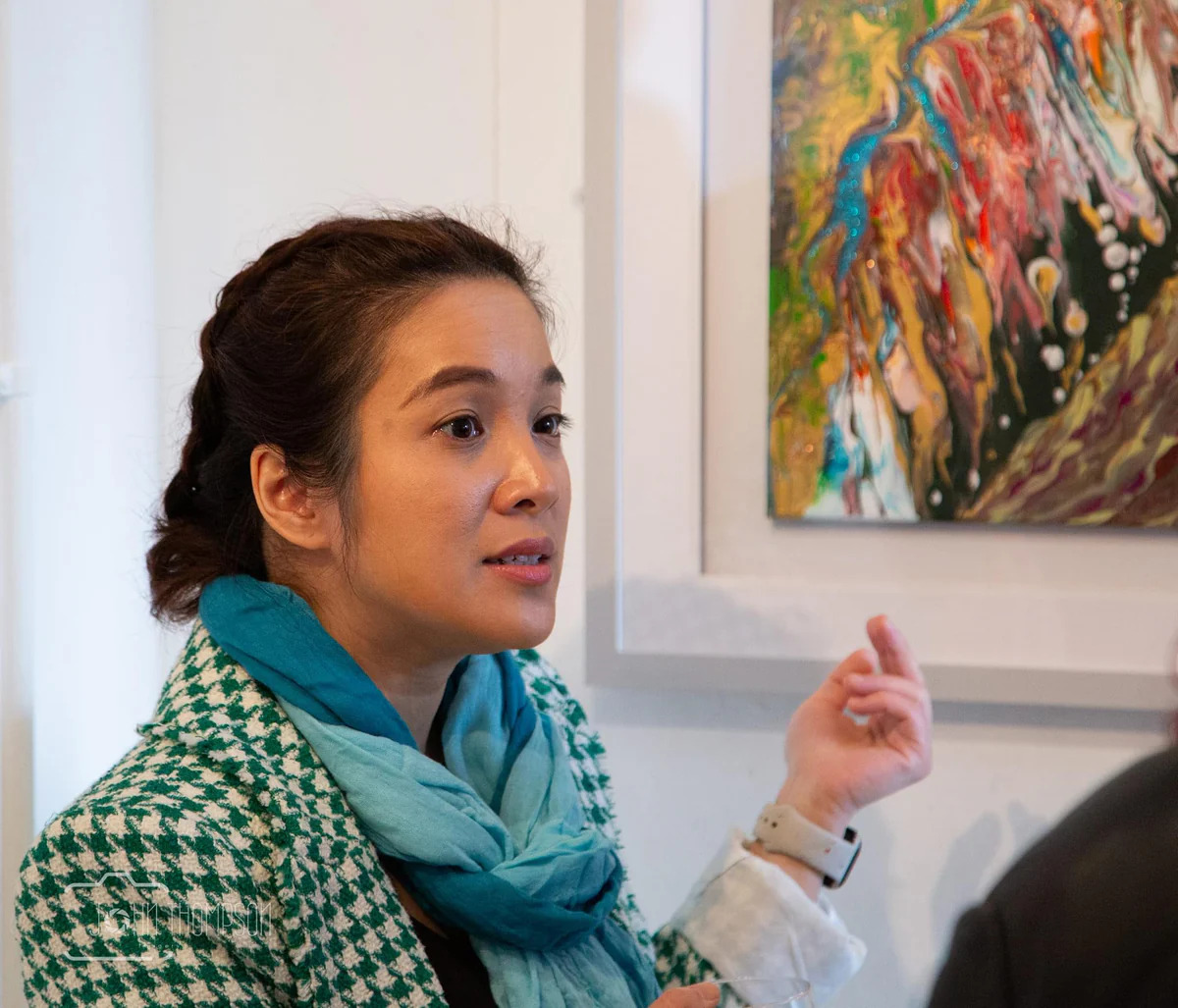
Huyen Phan displaying her works at Rugby Art Gallery & Museum. Image Credits: Huyen Phan.
Research supports this experience and concludes that art-based rehabilitation programmes offer something unique. Creative spaces allow prisoners to express themselves freely, rebuild confidence, and momentarily escape the psychological harms of confinement. In a system defined by confinement, art offers a rare opportunity for growth. Studies also show that participation in arts programmes in prisons can generate hope, strengthen identity, reduce aggression, improve emotional wellbeing, and increase engagement with other forms of rehabilitation. Inmates are often able to process emotion, develop patience, and rebuild a sense of identity.
James Latunji-Cockbill, producer of Art in Prisons at Ikon Gallery, echoes this research. He explained that prisoners often spend long periods alone in their cells, and art offers something that only few other interventions can. “When people are brought into an art studio away from the prison wings and shown artwork, they receive opportunities they’ve often never had before; it makes them think about the world differently,” he said.
He emphasised that the power of these programmes lies in how participants are treated. “We’re not there in uniform or with a badge. There’s no agenda, and they don’t get a qualification at the end. We’re simply sharing art and education for their sake. They feel treated as equals, not as a prisoner number. It becomes a safe space where they can decompress and breathe. I’ve seen with my own eyes the actual difference it makes to people’s lives.”
These ideas sit within a wider national debate about the state of prisons in the UK. Prisons in the UK are now in permacrisis. Overcrowding, crumbling infrastructure, severe staff shortages, and high re-offending rates continue to dominate public discussion. These conditions damage mental health and make personal progress increasingly difficult.
When prisons operate in constant crisis, rehabilitation becomes difficult. Without consistent opportunities to reflect, learn, or develop skills, people leave prison no better prepared for life outside than when they entered. According to the Times News, 41% of people released from prison re-offend within a year, and just 31% are in work six months after release.
Latunji-Cockbill believes this is precisely why rehabilitation matters. “People ask, ‘Why do this? They’re in prison for a reason,’ but almost everyone in prison will be released at some point. As a society, we have to decide what we want to do with people.” He argues that creative and therapeutic interventions can reduce re-offending.
“If people have a positive experience, learn something, and start thinking differently, they’re far less likely to return to prison. We need to ask bigger questions about the role of prisons and what role art can play within them.” For Phan, art became that turning point. Since her release, her work has received multiple awards at the Koestler Arts Awards.
She exhibited her paintings across London and the Midlands, and she now sells her work professionally. She is also currently an artist-in-residence at Leamington Spa East Lodge Art Studios and works with CAP UK to raise awareness of art’s role in mental health. Huyen Phan displaying her art at Under the Rainbow’s Winter Exhibition 2024 “When you start having studios and meeting other artists, you learn a lot. Even when a small piece sells, it feels like an achievement.
I want my art to bring happiness into other households,” she said. Her message is simple. “In prison, you’re stripped of everything. Even one brush, one pencil, or one piece of paper means something. You’re not asking people to sell art but to feel proud of creating something. Even a tiny achievement helps.” Naik has seen this first-hand and has received paintings from prisoners herself. Yet her perspective remains grounded in the realities of the system. “You can’t get emotionally involved with everyone,” she said. “Rehabilitation only works when someone is ready.
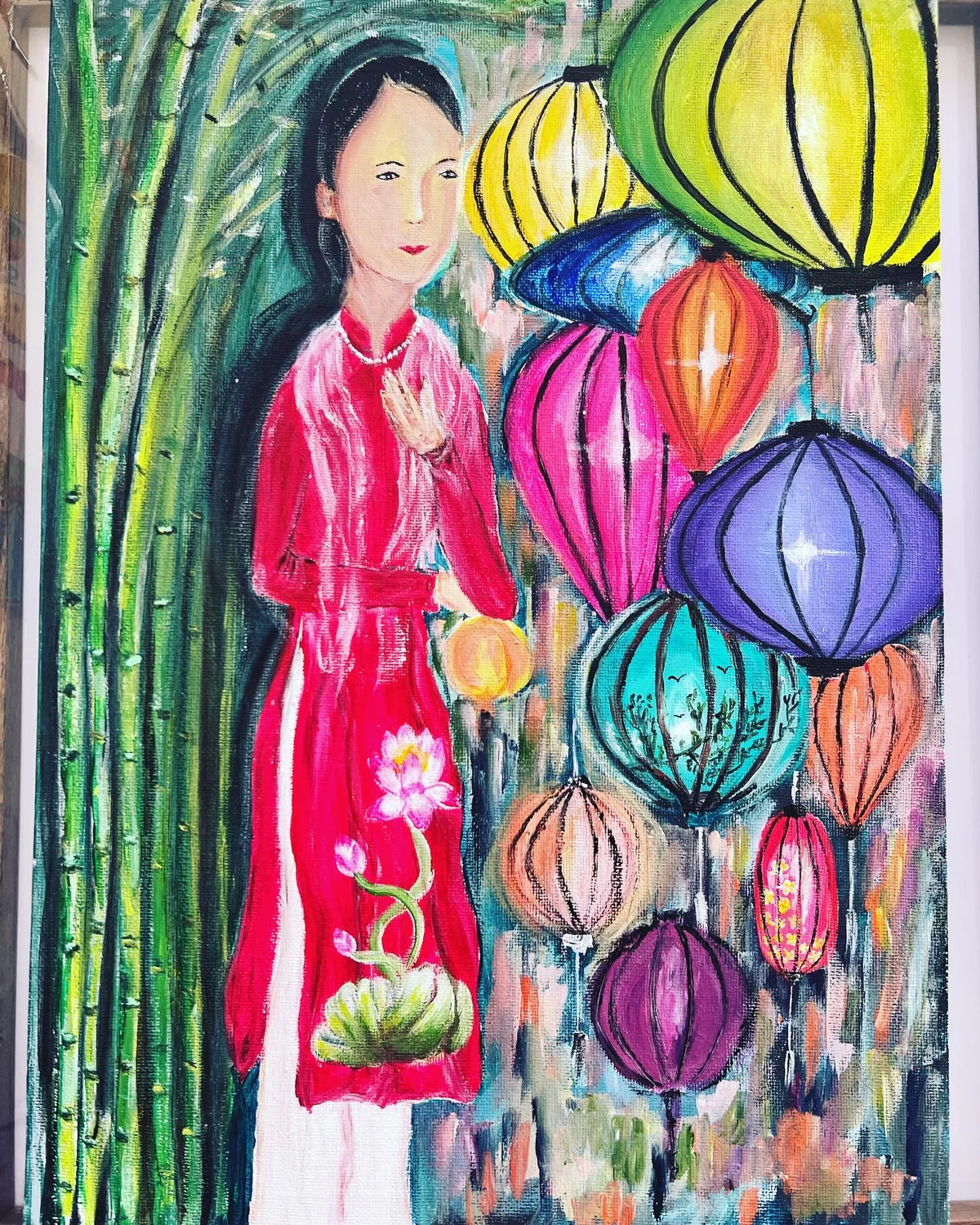
‘Vietnamese Lady’, an A2 Acrylic on canvas painted by Huyen Phan. Image Credits: Huyen Phan.
People don’t change because you tell them to; they change when their mindset does.” While art may not save everyone, for some, like Phan, it offers a moment of dignity, a sense of purpose, and a way forward – proof that even within confinement, something meaningful can still begin. Art does not excuse crime, but it helps people imagine a future beyond it.